

Basic Information about Japanese Trademark Applications
Typical Procedure Flow
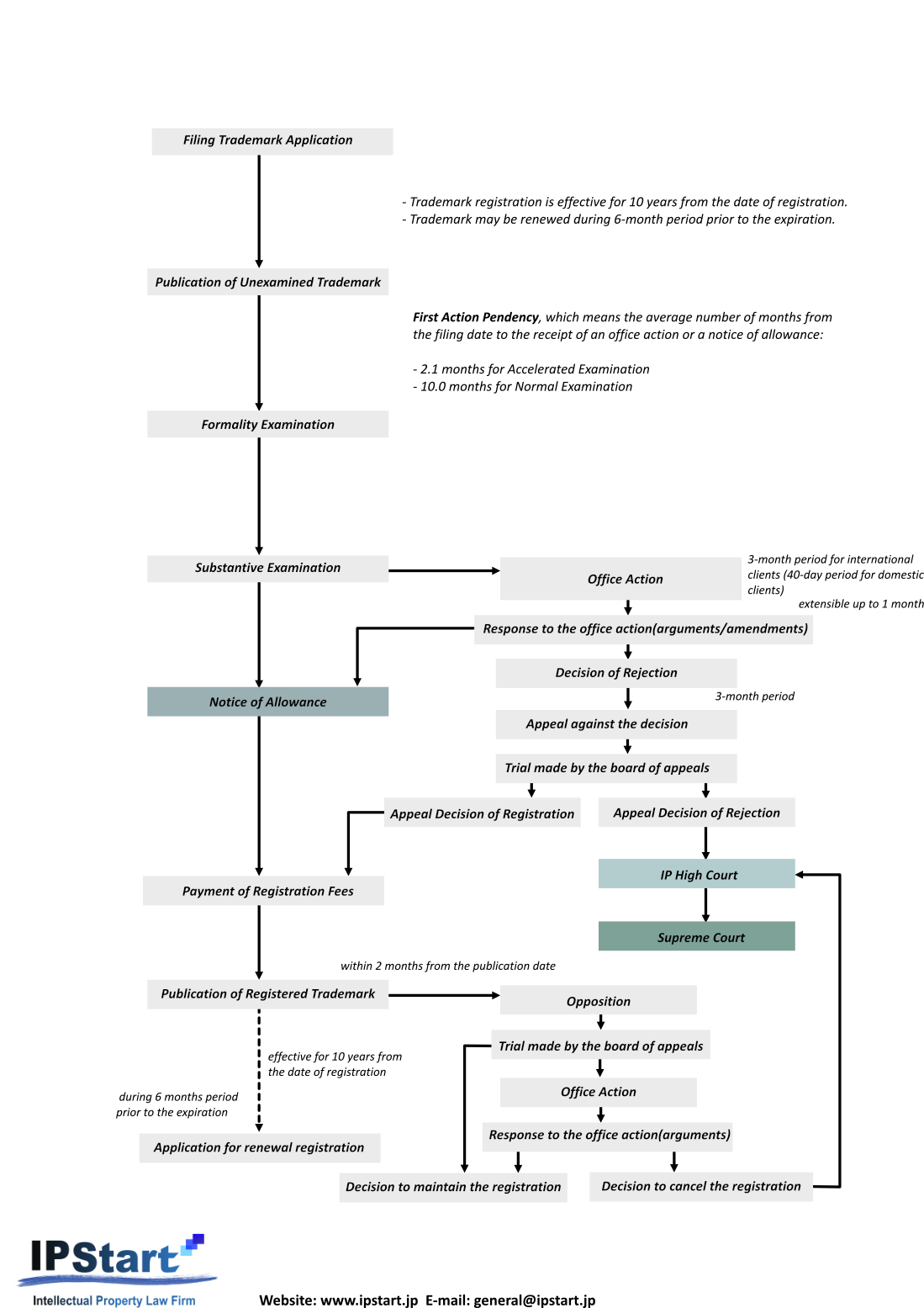
A PDF version of this image is available here. You may use it for commercial purposes, but please do not remove our logo when using the image. We retain all copyrights related to the image.
Disclaimer: While IPStart makes every effort to ensure the accuracy of the information, it does not guarantee or give any warranty as to the accuracy, timeliness or completeness of any information or material on our website.
Filing a New Application for Trademark Registration

Applicants need to submit an application form to the JPO. The application form includes the applicant’s name and address, the wording or figurative representation of the trademark to be registered, the designated goods or services, and the class of goods or services.
In addition to conventional marks such as word marks and logo marks, 3D-shape marks, motion marks, hologram marks, color marks, sound marks, or position marks can also be protected as eligible trademarks under the Trademark Law.
Designated goods are classified into Classes 1 to 34, and designated services are classified into Classes 35 to 45. For example, downloadable software is classified as Class 9, while providing non-downloadable software is classified as Class 42.
As the number of classes increases, the official fees for filing and registration increase.
JPO fees including filing fees and registration fees are calculated as follows.
- Filing fees: 3,400 JPY + 8600 JPY x N (N indicates number of classes.)
- Registration fees: 32,900 JPY x N (17,200 JPY x N for installment payment)
According to the IP Statistics Report 2026 issued by the JPO, a first action (FA) pendency for accelerated examination is 1.9 months, and the FA pendency for normal examination is 6.8 months. The FA pendency means the average number of months from the filing date to the mailing date of the first examination result (a first office action or notice of allowance). The average time from filing to grant is 7.8 months.
Regarding the accelerated examination, please refer to this document.
Publication

The pending trademark application is published approximately 3-4 weeks after filing.
Office Action

When an applicant receives an office action indicating reasons for refusal from the JPO, they are given an opportunity to submit a written opinion and/or amendment within 3 months (40 days for domestic clients) from the receipt date of the office action. The response due date may be extended up to 1 month by the payment of official extension fees (2,100 JPY). Failure to respond to the office action will result in a decision of rejection.
CONFLICT WITH A PRIOR REGISTERED TRADEMARK
For example, if a trademark is similar to a previously registered trademark owned by another person and some of the designated goods or services associated with the trademark are identical or similar to the goods or services associated with the previously registered trademark, the trademark application will be rejected based on the existence of the previously registered trademark.
In this case, an Applicant may consider arguing that the trademark is not similar to the previously registered trademark based on the three criteria of appearance, pronunciation, and conception. The applicant may also consider deleting some of the designated goods or services that are identical or similar to the goods or services associated with the previously registered trademark.
The similarity of designated goods and services is basically determined based on whether the similarity group codes assigned by the JPO are identical. For example, thermometers and gas meters share the same similarity group code, 10C01, and are therefore considered similar. On the other hand, fire alarms are assigned the similarity group code 09G04, while fire extinguishers are assigned 09G02, and thus the two are considered dissimilar.
QUESTIONS REGARDING USE
If multiple retail or wholesale services are designated in Class 35, depending on the similarity group codes assigned to those services, the JPO may issue a refusal under Article 3(1) of the Japanese Trademark Act on the ground that there is reasonable doubt as to whether the applicant is actually engaged in those services or genuinely intends to use the trademark for them.
In such cases, the applicant may respond by submitting evidence of actual business activities, or a written declaration of intent to use the trademark and a business plan. Other possible options include deleting some of the designated services such that the number of the similarity group code is limited to one.
For more information on refusals under Article 3(1) of the Japanese Trademark Act relating to Class 35 retail services and the available response strategies, please see the article below.

LACK OF DISTINCTIVENESS
A trademark application may also be refused on the ground that the applied-for mark lacks distinctiveness.
In such a case, it may be possible to argue either that the applied-for mark is inherently distinctive or that it has acquired distinctiveness through use under Article 3(2) of the Trademark Law.
In this regard, some reports suggest that, in recent years, the Japan Patent Office has taken a stricter approach to assessing distinctiveness. For example, one report indicates that, in 2023, the JPO upheld refusals based on lack of distinctiveness in 75% of the relevant appeal cases.
Decision of Rejection

An examiner’s decision of rejection is issued when the reasons for refusal remain unresolved after a response to the office action with arguments and/or amendments. In response to the decision of rejection, Applicants may file an appeal against the decision.
A request for appeal must be filed within three months after the receipt date of the decision. No extension of the due date is allowed.
When filing the appeal, a power of attorney must also be submitted. However, the applicant’s seal or signature is not required on the power of attorney.
It is also possible to request accelerated appeal examination in order to expedite the appeal proceedings. According to the JPO Status Report 2026, when accelerated appeal examination was requested, appeal decisions were issued in an average of 3.7 months in FY2025.
Appeal Proceedings

Appeal proceedings are conducted by the panel of appeal examiners.
When Applicants receive an appeal decision of registration, the trademark right is registered through the payment of registration fees.
On the other hand, when Applicants receive an appeal decision of rejection, they are given an opportunity to challenge the illegality of the appeal decision by filing a lawsuit for cancellation of the appeal decision with the Intellectual Property (IP) High Court (located at the Business Court in Nakameguro). The statutory deadline for filing the lawsuit is 120 days from the receipt date of the appeal decision (30 days from the receipt day for domestic clients).
Notice of Allowance

If a trademark application is allowed, the trademark right will be registered through the payment of the registration fees. The registration fees must be paid within 30 days from the receipt date of the notice of allowance. The registration fees can be paid in installments for the first 5 years and second 5 years. However, we do not recommend the installment payment in view of attorney’s service fees.
The trademark gazette is then published.
The trademark right is effective for 10 years from the registration date.
The duration of the trademark may be renewed by filing an application for renewal registration. The application for renewal registration must be filed during 6 month windows prior to the expiration of the trademark right. Thus, a trademark right can be made semi-permanent through the renewal registration.
Opposition

Any person may file an opposition to a registered trademark within two months after the publication date of the registered trademark. The opposition proceedings are held by the panel of trial examiners.
If the panel determines that the registered trademark should be cancelled for one or more reasons, an office action indicating reasons for cancellation will be sent to the trademark owner.
The trademark owner may submit arguments in response to the office action. The due date for responding to the office action is set to 3 months from the receipt date of the office action for international clients, and 40 days from the receipt day for domestic clients.
It should be noted that in an invalidation trial that is similar to the opposition system, only interested parties can file a request for invalidation trial. It should also be noted that, in principle, an invalidation trial may not be requested once five years have elapsed from the registration date, except where the request is based on public-interest grounds.
For more information on the latest trends in IPR filings in Japan, please refer to this article.

For our professional fees as well as official fees, please click the button below.