
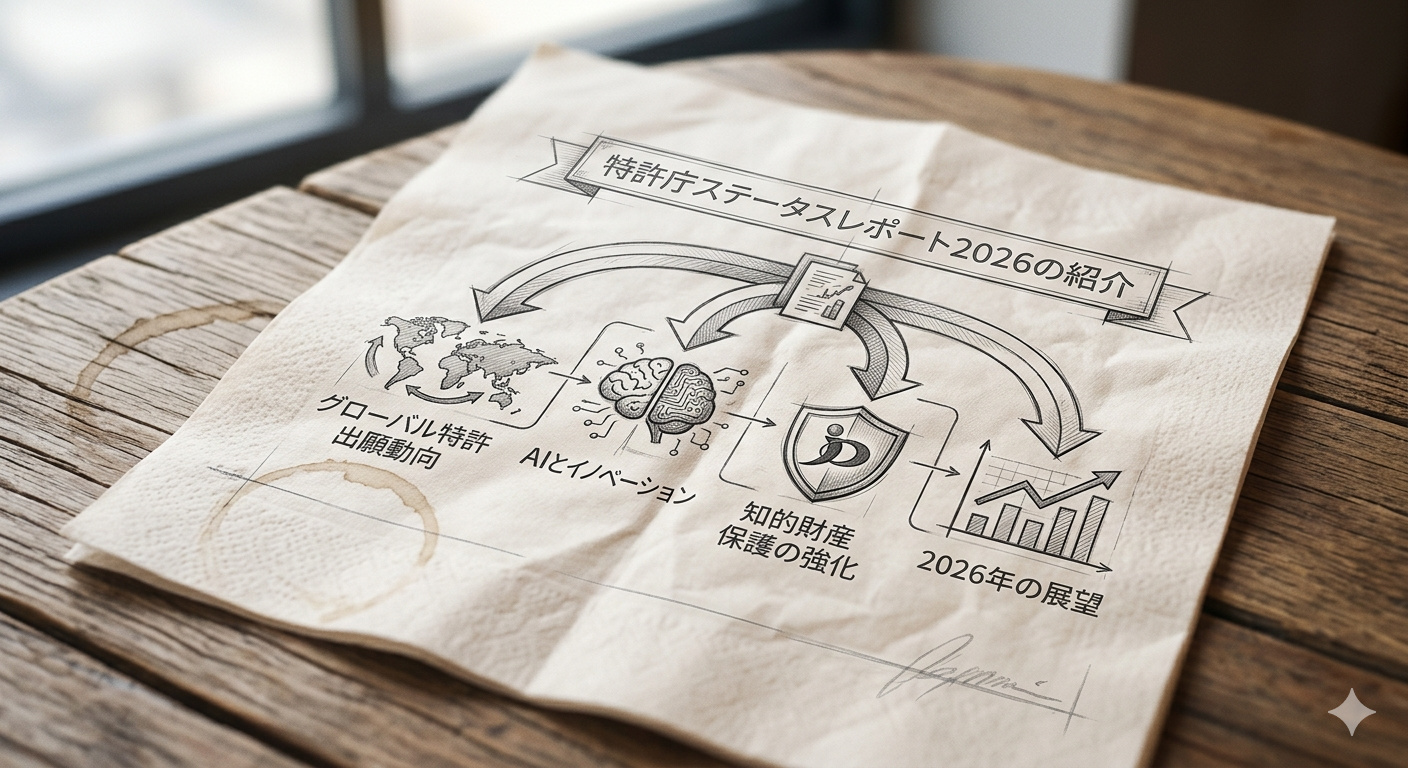
The Japan Patent Office (JPO) has published its Status Report 2026. In this article, we provide a brief overview of recent trends in Japanese IP filings by region and legal area, based on data from the report. All graphs referenced below are taken directly from the JPO Status Report 2026.
Patent Applications
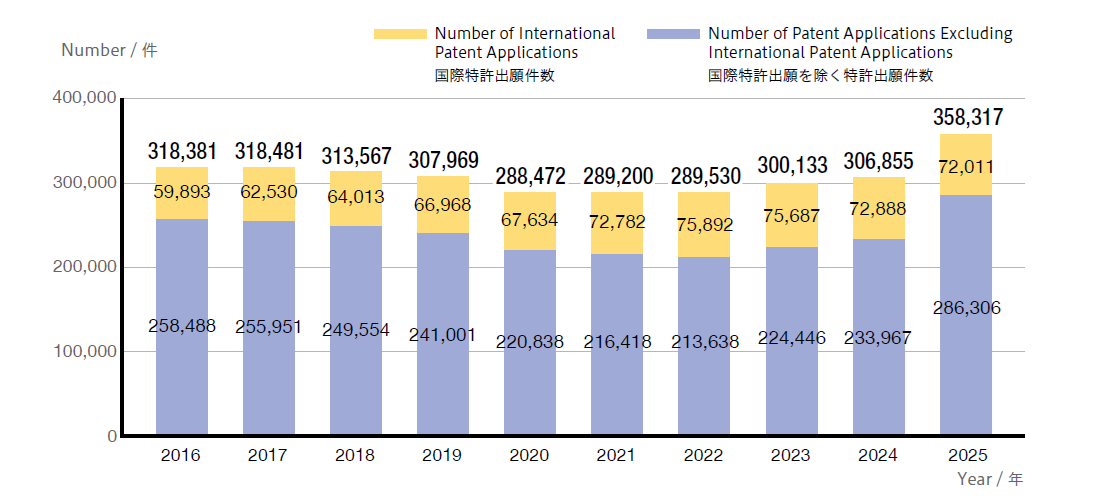
Number of patent applications in 2025: 358,317
‐National phase entries from PCT applications: 72,011
‐Patent applications excluding PCT national phase entries: 286,306
The total number of patent applications in 2025 increased significantly, marking the third consecutive year of growth. In particular, patent applications excluding PCT national phase entries increased by approximately 52,000 compared with the previous year.
Applicant Nationality Trends
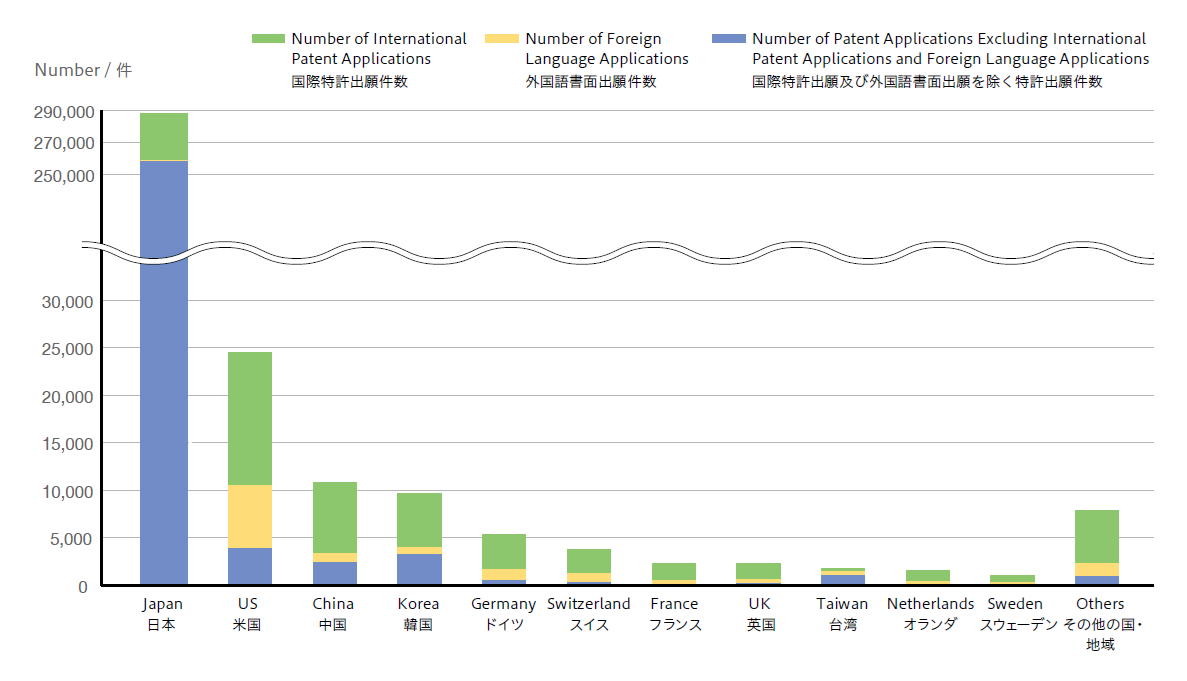
Excluding Japanese applicants, the top countries filing patent applications in Japan are, as in previous years:
- United States
- China
- South Korea
- Germany
Most foreign-originating Japanese patent applications are filed via the PCT route. Compared with applicants from other countries, U.S. and Korean applicants tend to rely more heavily on direct Paris Convention filings. U.S. applicants also tend to make relatively frequent use of foreign-language patent applications.
Trends in Japanese SMEs’ Patent Filings
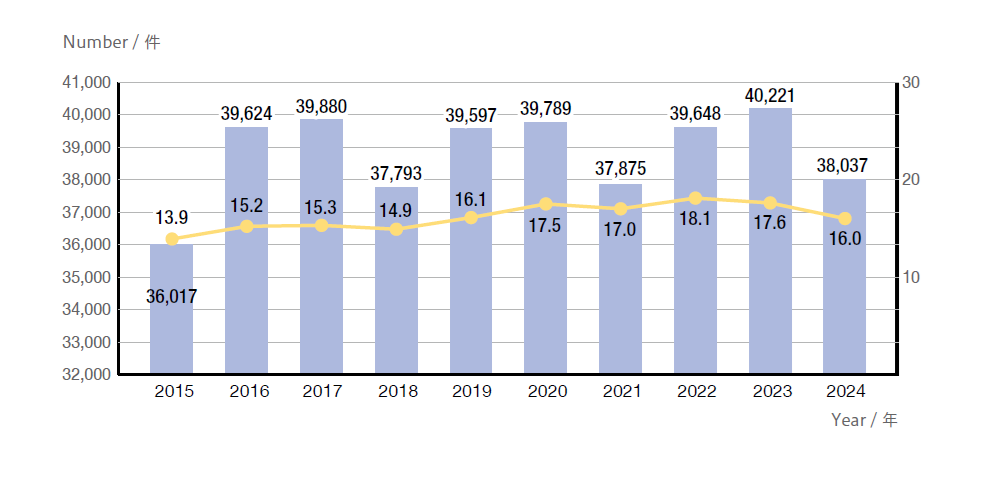
Patent applications filed by Japanese small and medium-sized enterprises (SMEs) amounted to approximately 38,000 in 2024, representing a decrease from the previous year. Over the past decade, the number of patent applications filed by Japanese SMEs has generally remained within the range of approximately 37,000 to 40,000.
Utility Model Applications
Number of utility model applications in 2025: 4,768
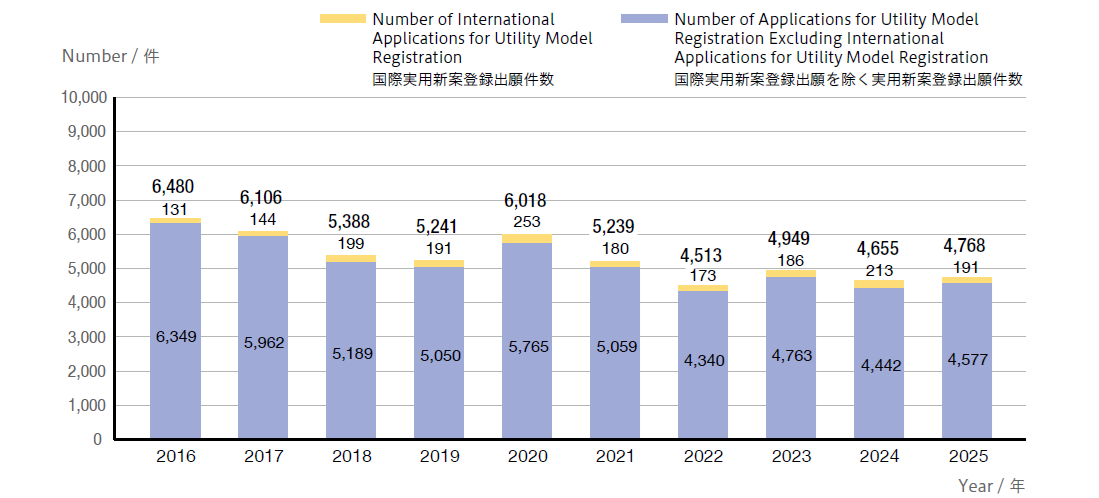
Although the number of utility model applications has been declining over the long term, filings have remained within the range of approximately 4,500 to 5,500 over the past five years.
Requests for Technical Opinion on Utility Models
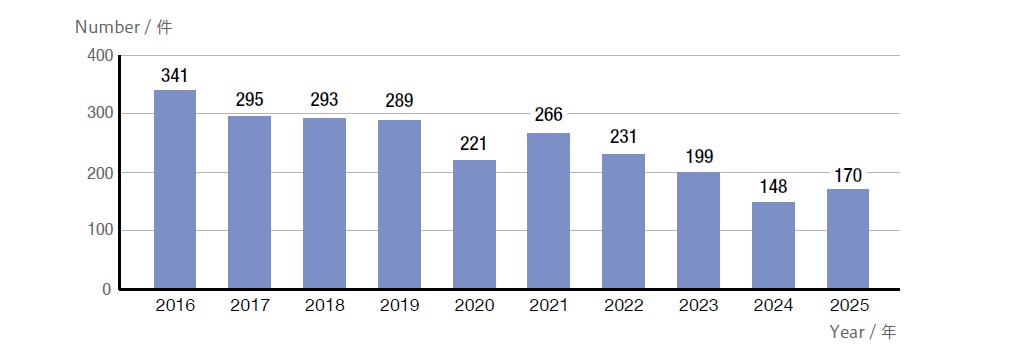
The number of requests for technical opinion on utility models has also continued to decrease.
Since utility model rights in Japan are registered without substantive examination, a request for a technical opinion from the JPO is required when enforcing a utility model right. This trend indicates that enforcement activity based on utility model rights remains limited.
Design Applications
Number of design applications in 2025: 31,781
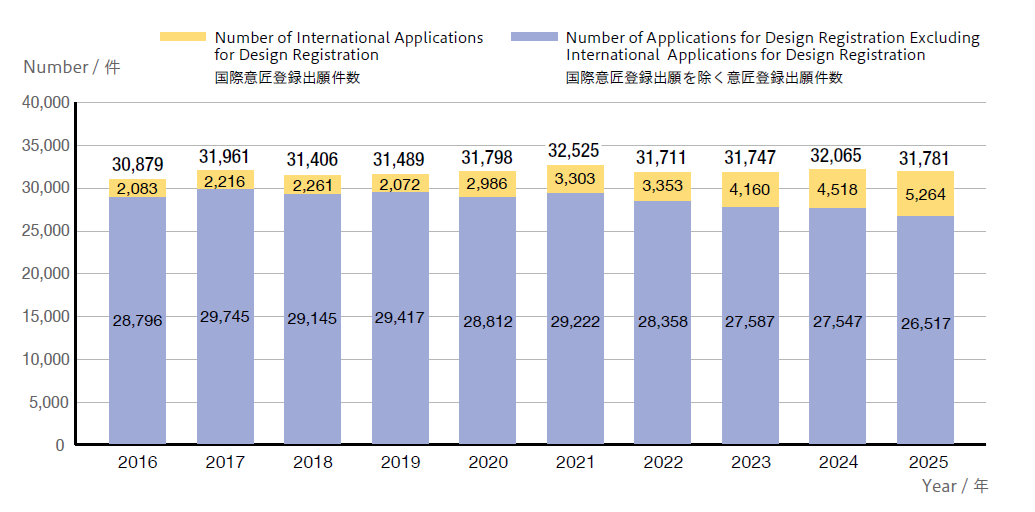
For design applications, the number of domestic design applications has remained relatively flat. On the other hand, the number of international design applications has been increasing year by year. Here, “international design applications” refers to international applications under the Geneva Act of the Hague Agreement that designate Japan and are internationally registered and published by the International Bureau.
Trademark Applications
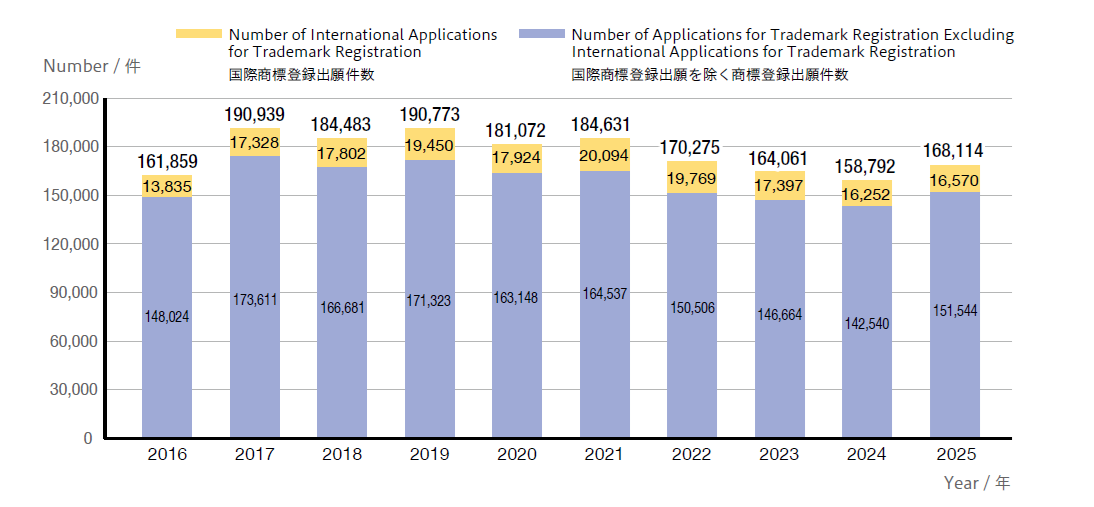
Number of trademark applications in 2025: 168,114
Trademark application numbers had been on a downward trend in recent years, but in 2025 the number increased.
Examination Trends
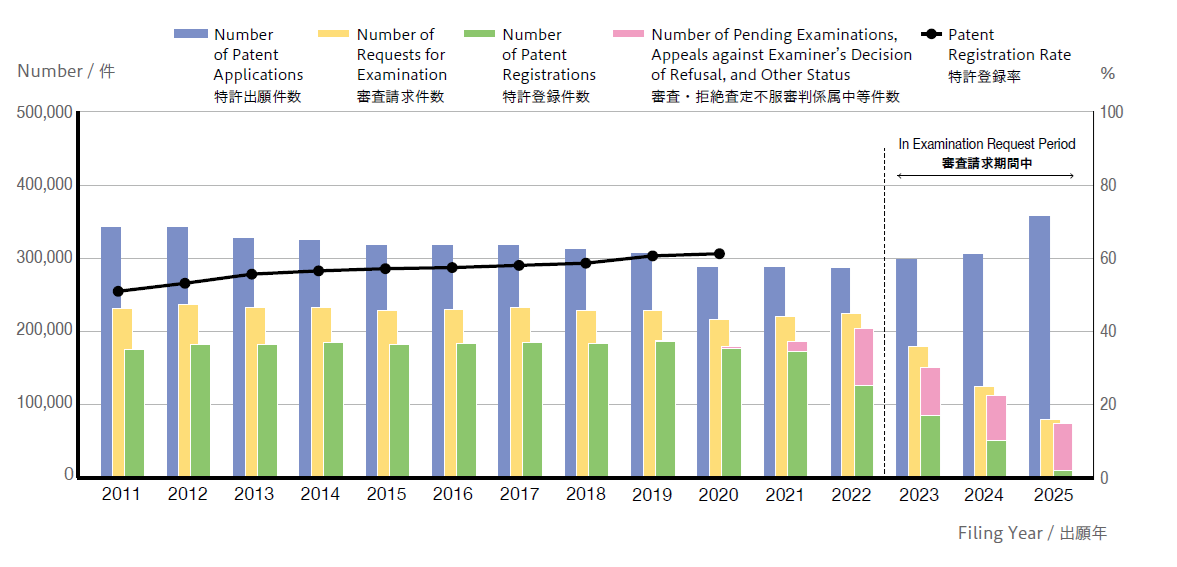
The following trends can be seen in patent filings, registrations, and grant rates, based on the year of application.
The number of patent registrations by filing year has remained stable. The patent grant rate has been gradually increasing and has recently reached approximately 60%. In addition, while the number of patent applications had been on a downward trend from 2011 to 2022, the number of examination requests remained relatively stable at around 230,000 during that period.
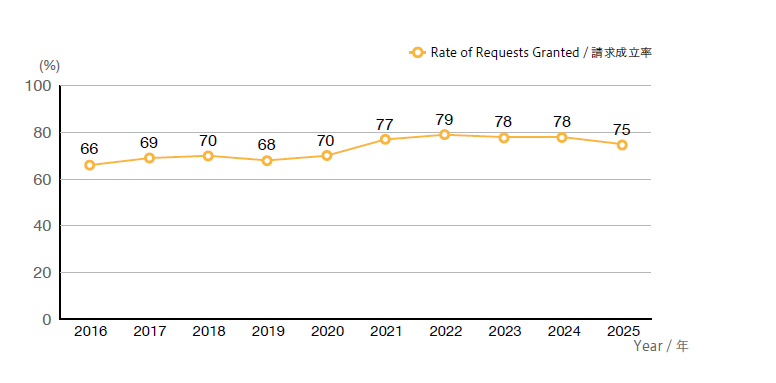
In 2025, the success rate for appeals against final rejections, excluding cases registered before the appeal decision, was 75%. In recent years, the success rate for such appeals has remained in the 70% range.
Appeals Against Final Rejections
The trends in the number of appeals against final rejections are shown below.
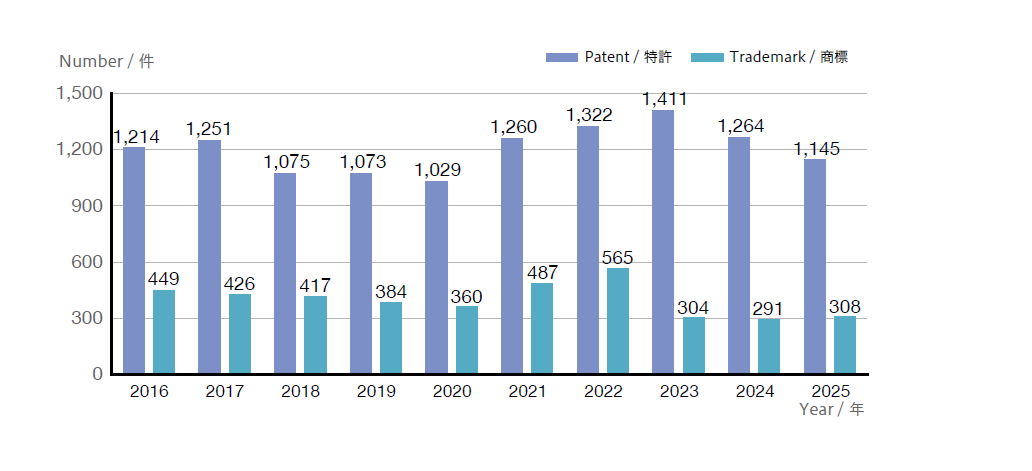
Opposition Filings
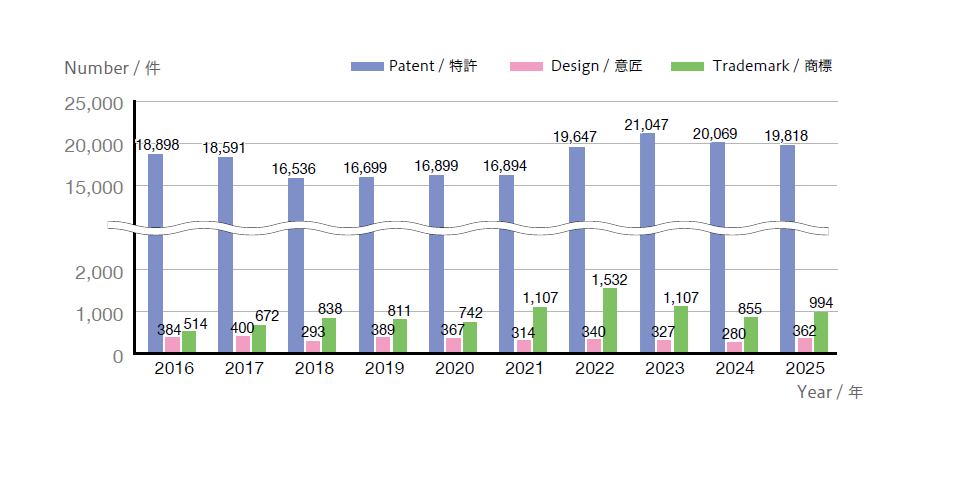
The trends in opposition filings for both patents and trademarks are shown below.
Invalidation Trials
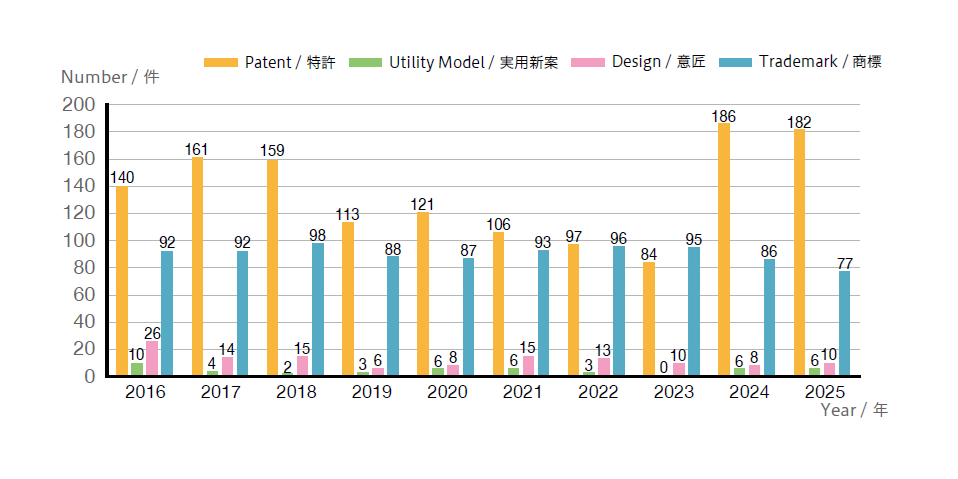
The trends in the number of invalidation trial requests in each legal area are shown below.
In recent years, approximately 100 requests for invalidation trials have been filed annually for both patents and trademarks. However, the number of patent invalidation trial requests increased sharply in 2024 and 2025. Based on recent publicly available patent invalidation trial decisions, many of these cases appear to involve certain tobacco companies and pharmaceutical companies.
Examination Timelines
Patents
- First Action (FA) period* under Super Accelerated Examination: 0.9 months
- For national phase entries from PCT applications: 1.7 months
- FA period under Accelerated Examination: 2.3 months
- FA period under Standard Examination: 9.1 months
- Average time from examination request to grant: 13.0 months
*“FA period” means the average number of months from the date of the examination request to the date of notification of the first examination result.
Designs
- FA period under Accelerated Examination: 2.0 months
- FA period under Standard Examination: 5.9 months
- Average time from filing to grant: 6.6 months
Trademarks
- FA period under Accelerated Examination: 1.9 months
- FA period under Standard Examination: 6.8 months
- Average time from filing to grant: 7.8 months
For both design and trademark applications, applicants can generally expect to receive examination results in about six months, and to obtain registration in approximately seven months.
Topics Under Discussion for Future IP System Reforms
The JPO Status Report 2026 also highlights several issues currently being discussed by the Patent System Subcommittee, the Design System Subcommittee, and other bodies under the Intellectual Property Committee of the Industrial Structure Council.
Key topics include the following:
- How the Japanese IP system should address the development of AI technologies, including issues relating to the concepts of “invention” and “inventor,” as well as the treatment of AI-generated outputs as prior art.
- The territorial scope of patent protection for network-related inventions in cross-border business activities. The Supreme Court of Japan recently found infringement of a Japanese patent even though part of the relevant system was located outside Japan. However, the precise scope of such cross-border patent enforcement remains an important issue.
- How designs in virtual spaces should be protected under the Japanese Design Act.
- Measures to deter IP infringement more effectively, taking into account the substantial financial and human resource burdens involved in patent infringement litigation.
- Procedural reforms, including the introduction of online filing and electronic communication through e-PCT, and the abolition of the deemed withdrawal of an earlier application on which a domestic priority claim is based.
Source
JPO Status Report 2026:
https://www.jpo.go.jp/resources/report/statusreport/2026/index.html